
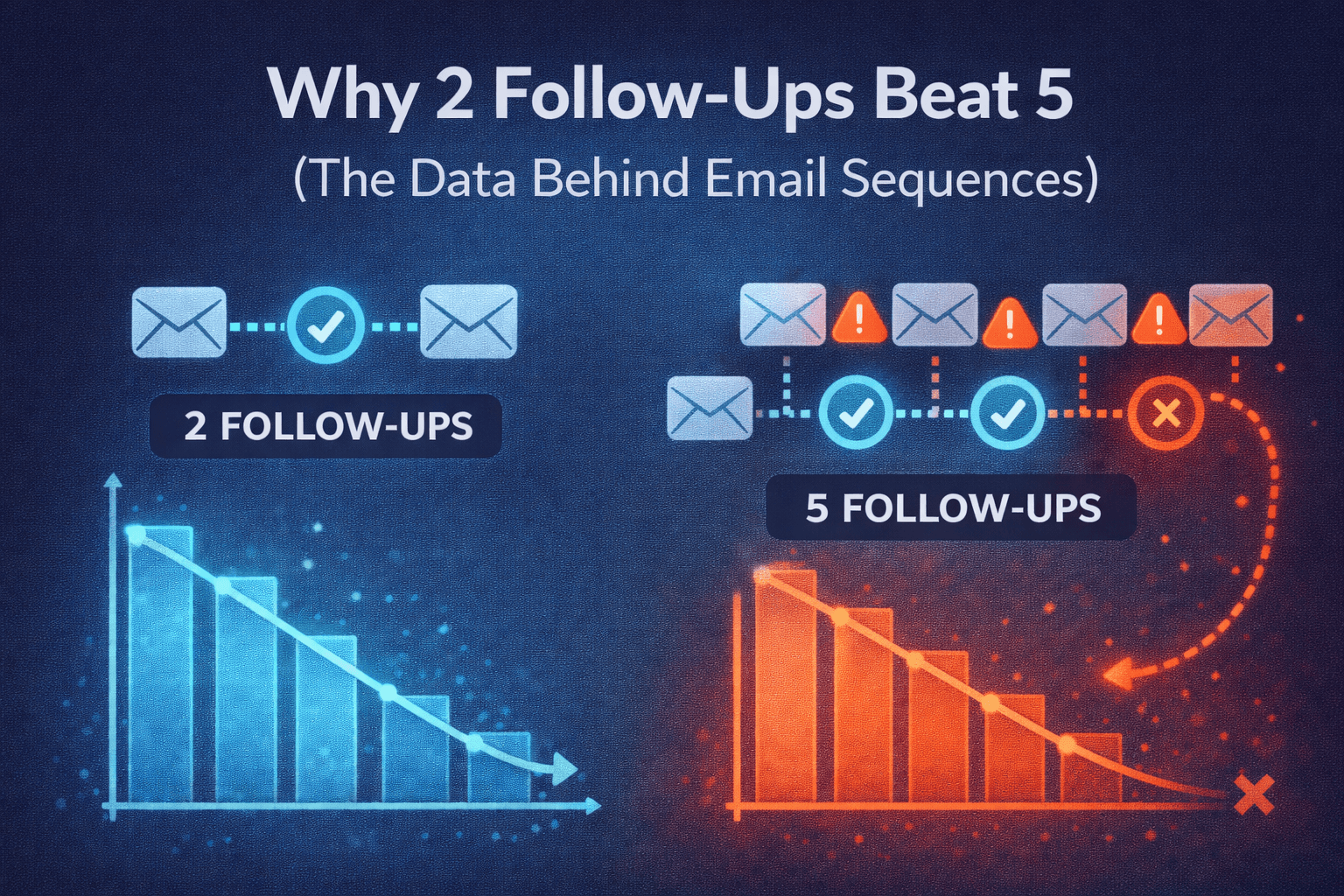
The cold email industry has a favorite piece of advice: "Send 5-7 follow-up emails because most responses come from follow-ups."
It sounds logical. It's backed by data showing that response rates increase with each email. So more emails must be better, right?
Wrong.
The Problem with the "More Emails = More Replies" Logic
Yes, it's true that follow-ups generate responses. Studies show that email 2 gets more replies than email 1 alone, email 3 gets more than emails 1-2 combined, and so on.
But this analysis misses something critical: the long-term cost to sender reputation.
Here's what the data actually shows when you factor in deliverability:
| Email # | Incremental Reply Rate | Spam Complaint Rate | Net Value |
|---|---|---|---|
| 1 | Baseline | Very Low | High |
| 2 | +3-5% | Low | High |
| 3 | +1-2% | Medium | Medium |
| 4 | +0.5-1% | Medium-High | Low |
| 5+ | +0.1-0.5% | High | Negative |
By email 5, you're getting maybe 1 extra reply per 200-500 emails sent, while generating spam complaints that damage your domain reputation for future campaigns.
The Hidden Cost of Aggressive Sequences
When someone marks your email as spam, email providers learn. That feedback affects:
- Your domain reputation - Future emails more likely to hit spam
- Your IP reputation - If shared, affects everyone on that IP
- Your pattern recognition profile - Providers learn to flag your sending style
One spam complaint can offset the positive signal from multiple successful deliveries. The math doesn't favor aggressive follow-up sequences.
What the Top Performers Actually Do
We analyzed data from clients who consistently achieve 10%+ reply rates. Their approach:
Sequence structure:
- Initial email (Day 1)
- One follow-up (Day 4-5)
- That's it.
But wait - where do all the replies come from?
From recycled campaigns.
The List Recycling Approach
Instead of pestering prospects with 7 emails over 3 weeks, top performers:
- Send 2 emails (initial + 1 follow-up)
- Wait 2 months
- Contact the same list with a completely different angle
This works because:
- Memory fades - Prospects don't remember your email from 2 months ago
- Circumstances change - Budgets reset, priorities shift, pain points evolve
- Fresh offers resonate differently - What didn't land in January might hit in March
The Math: 5 Emails vs. Recycling
Traditional 5-email sequence (single campaign):
- 5,000 prospects
- Emails 1-5 over 3 weeks
- ~2.5% cumulative reply rate
- 125 replies
- 15+ spam complaints damaging reputation
2-email sequence with recycling (same time period):
- 5,000 prospects
- Campaign 1: 2 emails → ~2% reply rate → 100 replies
- Wait 2 months
- Campaign 2: 2 emails, new angle → ~1.5% reply rate → 75 more replies
- Wait 2 months
- Campaign 3: 2 emails, another angle → ~1% reply rate → 50 more replies
6-month comparison:
- Traditional: 125 replies, degraded reputation
- Recycling: 225 replies, maintained reputation
The recycling approach generates nearly 2x the replies while preserving sender reputation for future campaigns.
What Changes Between Campaigns
"New angle" doesn't mean changing two words. It means fundamentally repositioning your value proposition:
Campaign 1: Lead with the problem you solve "We help SaaS companies reduce churn by identifying at-risk customers before they cancel."
Campaign 2: Lead with social proof "Companies like [Similar Company] reduced churn 23% using our platform."
Campaign 3: Lead with a resource "I put together a guide on the 5 warning signs a customer is about to churn. Want a copy?"
Each campaign feels fresh because it is fresh - different hook, different value prop, different call to action.
Why 2 Months Is the Magic Number
| Wait Time | Prospect Memory | Your Risk |
|---|---|---|
| 2 weeks | "Didn't I just hear from them?" | High |
| 1 month | "This sounds familiar..." | Medium |
| 2 months | "Don't remember this" | Low |
| 6+ months | Data may be stale | Medium |
Two months is long enough for memory to fade but short enough that your contact data remains accurate.
The Exception: High-Intent Signals
There's one case where more follow-ups make sense: when you have a high-intent signal.
- They visited your pricing page
- They downloaded your whitepaper
- They replied but went quiet
In these cases, the prospect has already shown interest. More follow-up isn't pestering - it's persistence with a warm lead.
But for pure cold outreach? Two emails, then move on.
Implementation Tips
For your initial email:
- Focus on one clear value proposition
- Keep it short (under 100 words)
- End with a simple ask
For your follow-up:
- Reference your first email briefly
- Add one new piece of information or angle
- Keep it even shorter than the first
For recycled campaigns:
- Wait the full 2 months
- Change the subject line completely
- Lead with a different value prop
- Don't reference previous emails
The Bottom Line
The cold email industry optimizes for the wrong metric. Reply rate per sequence doesn't matter if you're burning your sender reputation in the process.
Optimize for replies per lead over time, not per sequence. Two emails plus recycling beats aggressive sequences every time.
Your leads are an asset. Treat them like one.
Want to implement this strategy? Our system automatically handles the 2-email sequence and helps you manage list recycling timing. Learn more about our approach.